


































The 9 Worst Things You Could Do in Your Teacher Emails
The 9 Worst Things You Could Do in Your Teacher Emails
Improve your school email marketing by avoiding nine mistakes that hurt deliverability, teacher engagement, and enquiries.
Improve your school email marketing by avoiding nine mistakes that hurt deliverability, teacher engagement, and enquiries.


You could have the best educational resource on the market. You could have a workshop that teachers genuinely love, software that saves schools hours every week, or a service that delivers excellent results. Yet if your email doesn't encourage educators to keep reading, none of that really matters.
We see this all the time. One organisation spends months refining its product before sending a beautifully designed campaign that generates almost nothing. Meanwhile, another business with a fairly average offering fills its diary with enquiries because its emails are clearer, more relevant, and easier for busy teachers to engage with.
Successful school email marketing depends on how clearly and quickly the message earns attention. Teachers are often reading between lessons, replying to parents, preparing resources, or catching up at the end of a long day, so anything that feels cluttered, vague, or unnecessarily difficult can lose them within seconds.
Across the campaigns we’ve seen, the same mistakes keep appearing; some weaken engagement, some reduce inbox placement, and others make a strong offer feel far less appealing than it really is.
Here are nine of the worst.
1. Turning your email into a brochure
It's understandable why businesses do this. They've invested in professional branding, commissioned attractive graphics, and want every email to showcase everything their organisation has to offer. But what works for a brochure rarely works for an email.
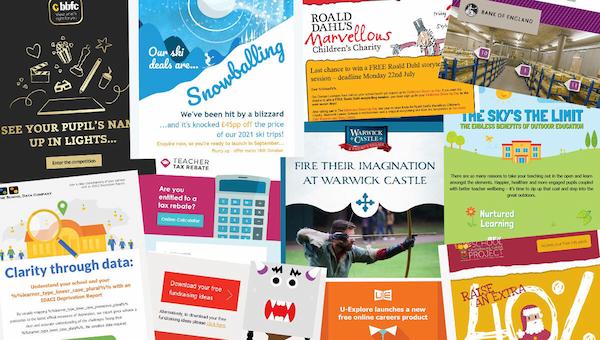
Many school marketing emails resemble miniature websites, packed with banners, icons, colourful boxes, multiple buttons, social media links, and enough graphics to fill an exhibition stand. Rather than making the email easier to consume, all of that design competes for attention.
There's also another consideration that many businesses overlook. Schools operate behind increasingly sophisticated email filtering systems, designed to protect staff from phishing attacks, malicious emails and spam. While images certainly have their place, heavily designed emails can sometimes attract greater scrutiny than simpler, more balanced campaigns.
The best-performing teacher emails are often surprisingly restrained. They still look professional, but the design supports the message rather than becoming the message. One clear image will usually outperform six decorative ones, especially when the reader only has a minute to decide whether your email deserves their attention.
2. Talking about yourself for the first half of the email
"We've been established for 25 years."
"We're passionate about education."
"Our award-winning organisation..."
If the opening paragraph of your email reads like the ‘about us’ page from your website, you've probably lost a good proportion of your audience already.
That isn't because teachers don't care who they're buying from. They absolutely do. Schools want to work with organisations they trust, particularly when budgets are tight and every purchasing decision carries more scrutiny than it used to.
But before teachers care about who you are, they want to know why you've taken the time to email. What problem are you solving? How will this help their pupils? Why should they keep reading?
Once you've answered those questions, your credibility becomes much more valuable because it's supporting a benefit the reader already understands.
Think about it from the teacher's perspective. If someone walked into the staffroom and spent five minutes talking about themselves before explaining why they'd come, most people would lose interest fairly quickly. Marketing emails work much the same way.
3. Trying to sell everything at once
Some businesses seem determined to squeeze an entire year's worth of marketing into a single email.
A free guide. Then a webinar. Three other products suddenly introduced halfway down. Then two testimonials, Oh and here’s a seasonal offer. And all of our social media links, even the ones we haven't updated since 2019.
By the time the teacher reaches the bottom of the email, they've been asked to do six different things, which often results in them doing none of them.
Businesses aren’t doing this intentionally - it’s usually because they worry they won’t get another opportunity to speak to that school, or want to give the school everything they need to make a decision there and then. But it creates the opposite effect. Instead of making the company feel helpful and trustworthy, teachers are often overwhelmed and confused.
The strongest marketing emails generally have one clear objective. Maybe it’s to promote a workshop, encourage teachers to download a guide, or invite schools to book a demo. Whatever the goal, every paragraph should help move the reader towards that single action.
Teachers already make tons of decisions every day - so your email shouldn't ask them to make another five before they've even clicked the first link.
4. Packing the email with things that trigger spam filters
Every extra element in your email gives a school’s filtering system something else to inspect.
That includes obvious links to landing pages and booking forms, but also tracking URLs, social media icons, image links, large graphics, attachments, repeated buttons, and redirects added by email platforms. A campaign can look perfectly reasonable to the person sending it, while the underlying email contains far more code, imagery, and promotional signals than they realise.
Schools operate within heavily protected email environments, where incoming messages are checked for signs of phishing, fraud, malicious redirects, and suspicious sending behaviour. An email crowded with links, images, tracking, and sales-heavy formatting can therefore face greater scrutiny, especially when those elements point to several different domains or add unnecessary technical weight.
The risk becomes even greater when businesses use shortened URLs, attach links to every image, add bulky footers, rely on image-heavy templates, or include social icons that contribute nothing to the main purpose of the campaign. Each extra element gives filters another reason to question whether the email belongs in a teacher’s inbox.
Keep the email technically clean. Use a small number of direct, trustworthy links, maintain a sensible balance of text and images, avoid unnecessary attachments and redirects, and remove anything that’s there purely because it appeared in the template.
You may lose a few decorative elements or pieces of tracking data, but you’ll give the campaign a cleaner structure and a better chance of reaching the people it was written for.
5. Forgetting who you’re actually emailing
It’s very easy to forget that the person opening your email doesn’t know your business nearly as well as you do.
You’ve spent months, perhaps years, immersed in the product. You know what every feature does, you understand the terminology, and phrases such as “multi-layered intervention pathways”, “automated curriculum mapping”, or “integrated provisioning workflows” may feel completely natural. To a teacher seeing your name for the first time, they can create more questions than answers: what does the product actually do, where would it fit, and who in the school would use it?
That’s where otherwise strong emails start to wobble. The copy may be polished, the offer may be genuinely useful, and the design may look great, but the reader is still left piecing together what you actually do. A busy teacher shouldn’t have to decode the value from a paragraph full of industry language, product terminology, and claims that could belong to almost any education supplier.
Plain English helps, although plain doesn’t have to mean flat. Good copy can still be sharp, distinctive, funny, warm, surprising, or persuasive; it simply needs to give the reader something solid to understand. “Save your maths lead three hours a week” has more to hold onto than “streamline curriculum delivery”, while “give pupils a live courtroom experience in your school hall” paints a much clearer picture than “deliver immersive enrichment”.
The best teacher emails feel as though someone has considered the person at the other end before pressing send. They use the reader’s language, answer the questions that person is likely to have, and make the benefit obvious without sanding all the personality off the copy.
6. Sending the same email to everyone
This is one of the easiest traps to fall into because it feels efficient.
You've got a product that works for schools, so you write one solid email, build one audience, press send, and hope it resonates with as many people as possible. It saves time, keeps the campaign simple, and feels like the sensible thing to do.
The trouble is, schools aren't one audience.
Take something as simple as an online maths platform. A headteacher might be wondering whether it'll raise attainment across the school. The maths lead is probably thinking about curriculum fit and teacher workload. A business manager may not care about either of those until they understand the cost, contract length, and how difficult it'll be to roll out.
They're all looking at the same product. They're just looking at it through completely different lenses.
We've seen businesses make huge improvements to campaign performance without changing the product, the offer, or even the design of the email. Sometimes they've simply split one campaign into three or four versions, changed the opening paragraph, swapped a couple of examples, and made the call to action feel more relevant to each audience. Suddenly the email feels like it was written for the reader rather than sent to a list.
It takes a little longer, but that's usually time well spent. Teachers respond to relevance. The closer your email reflects the challenges, priorities, and language of the person reading it, the less work they have to do to picture your product in their school.
7. Making the next step feel like hard work
A surprising number of school marketing emails do a really good job of generating interest, then ask the reader for far too much, far too soon.
Imagine you're a teacher who's just read about a workshop that sounds genuinely useful. You click the button expecting to see a few more details, only to land on a page asking you to book a 45-minute demonstration, complete a lengthy enquiry form, or arrange a call with sales before you've even seen the price or what's included.
For many teachers, that's enough to close the tab.
Schools are busy places, and decisions like these are often squeezed into ten spare minutes between lessons, lunchtime, meetings, or the end of the school day. If the next step feels time-consuming or asks for a bigger commitment than the teacher was expecting, it's very easy for the email to slip down the priority list until it's forgotten altogether.
The best-performing campaigns often let interest build naturally. Someone who's only just discovered your organisation may want to browse a few examples, watch a short video, download a guide, or see how the product works before deciding whether they'd like to speak to somebody. Each step builds a little more confidence, making the next one feel much easier.
We've seen businesses generate more enquiries after making surprisingly small changes to what happens after the click. Shorter forms, clearer calls to action, fewer compulsory fields, and landing pages that answer the obvious questions before asking for contact details all help keep that momentum going. This creates a much smoother experience for a busy teacher who's already decided you're worth exploring.
8. Sending it at the wrong time of year
You can write a brilliant email, build the right audience, and still get very little back because schools simply aren’t thinking about your offer yet.
That’s one of the frustrating things about marketing to schools: timing can make a strong campaign look weak. A residential provider might launch just after schools have finished booking next year’s trips, while a revision resource lands when teachers are already buried in exams and running out of time to introduce anything new. The email hasn’t suddenly become poor, but it’s arrived after the useful window has started to close.
The school year has its own rhythm, and it doesn’t always match the timetable businesses have in mind. Budgets, exams, inspections, inset days, new-term planning, staffing changes, and holidays all compete for attention, so a campaign that feels well timed in the office can feel wildly inconvenient in a school.
We’ve seen organisations keep rewriting an email because the first send underperformed, when the copy was never really the main issue. The campaign needed to arrive three weeks earlier, one half term later, or before schools had already made the decision it was asking them to make.
That’s why good marketing to schools needs a proper understanding of when the problem becomes urgent, when budgets are available, and when teachers are most likely to have the headspace to act. Businesses often spend hours refining the copy when they'd see a bigger improvement by launching exactly the same email a few weeks earlier or later.
9. Measuring success by open rates alone
Open rates still have their place, although they've become one of the most misunderstood figures in email marketing.
It's easy to become fixated on whether a campaign achieved 28% or 32%, particularly when most email platforms put that number front and centre. The reality is that open rates have become far less reliable over recent years, thanks to privacy changes, tracking restrictions, and the way different email providers now handle tracking pixels.
More importantly, an open doesn't necessarily tell you whether the campaign achieved anything meaningful.
We've seen campaigns with fairly ordinary open rates generate fantastic enquiries because the right schools engaged with the offer. We've also seen campaigns with excellent opens that produced very little because plenty of teachers looked at the email, then carried on with their day.
Ultimately, the figures that matter most are the ones that move your business forward. Replies, meetings booked, resource downloads, enquiries, and sales all tell you far more about the effectiveness of a campaign because they reflect genuine interest rather than a single interaction with an inbox.
Give your teacher emails a better chance
Underperforming emails often carry a handful of avoidable problems that weaken the message, reduce inbox placement, or make the next step feel harder than it should.
A sharper audience, cleaner setup, stronger timing, and copy written around the person reading it can change the results considerably. We see that every day across the campaigns we plan, write, and send for organisations marketing to schools.
Book a strategy call with Sprint Education and we’ll look at your audience, timing, content, and delivery setup, then help you identify where the campaign may be losing ground.
Tags
Marketing to Education
Marketing to Schools
Marketing to Teachers
Selling to Schools
Selling to Teachers
Similar Articles

Value Assets and Their True Worth
Become a lead-magnet legend and sell more to schools with our free 11-step guide to creating value assets that teachers can't resist.
Read Post
Data-Driven Education Marketing Success – Strategy Frameworks
Discover how our managed campaigns are built to supercharge your selling-to-schools results
Read Post