






































The New Ultimate Guide to Selling to Schools
The New Ultimate Guide to Selling to Schools
Go from novice to pro with our modern education marketing guide designed to help businesses generate stronger results when selling to schools.
Go from novice to pro with our modern education marketing guide designed to help businesses generate stronger results when selling to schools.


Marketing to schools has become significantly more challenging over the past few years. Campaigns that once generated a healthy flow of enquiries from teachers and school leaders are now producing weaker engagement; meanwhile, school inboxes are more crowded than ever, budgets are under greater scrutiny, and educators are becoming increasingly selective about the suppliers they interact with.
For businesses entering the education sector, this often comes as a surprise. Many organisations assume schools behave similarly to traditional commercial buyers, only to discover that education operates according to very different pressures, priorities, and decision-making structures. Purchasing journeys are slower, buying committees are fragmented, and trust plays a far larger role than many suppliers initially expect.
At Sprint Education, we’ve now supported more than 14,000 education brands with marketing campaigns targeting schools, colleges, MATs, districts, and international education markets. Through our education database, marketing campaigns, and sales development services, we’ve seen exactly how school buying behaviour has evolved – and why many traditional education marketing strategies no longer perform as they once did.
This guide explores how modern businesses successfully sell to schools today, from understanding how schools buy, to improving email deliverability, reaching decision-makers more effectively, generating school sales leads consistently, and adapting to the new realities shaping education marketing.
Why Selling To Schools Is Different From Other Sectors
One of the biggest mistakes businesses make when marketing to schools is assuming educators behave like typical B2B buyers. Schools operate within environments shaped by safeguarding responsibilities, limited budgets, staff workload pressures, inspection demands, and increasingly stretched resources. As a result, purchasing decisions tend to be more cautious, more layered, and more relationship-driven than many suppliers anticipate.
In most schools, buying decisions rarely sit with a single person. A classroom teacher may initially discover a product, while a head of department evaluates curriculum fit, a school business manager examines affordability, and senior leadership ultimately signs off the purchase. Within MATs, the process can become even more complex, with trust-wide procurement frameworks and centralised purchasing structures influencing decisions across multiple schools.
This means businesses need to understand far more than simply “who to email”. Successful selling to schools depends on understanding how educational organisations actually operate internally.
Schools also behave seasonally in ways many businesses underestimate. Engagement levels fluctuate dramatically throughout the academic year depending on:
- Exam periods and assessment windows.
- School holidays and staff absence levels.
- Budget planning cycles.
- Inspection activity.
- Timetable pressures.
- Curriculum planning periods.
- Recruitment and staffing pressures.
A campaign launched at the wrong moment can significantly underperform regardless of how strong the product or messaging may be.
The organisations generating the strongest results within the education sector are usually those that adapt their strategy around school behaviour, rather than forcing generic commercial marketing methods into an education environment that functions very differently.
Understanding The Different Types Of Schools
Many businesses target “schools” as though the sector operates as one unified audience. In reality, education contains multiple sub-sectors with entirely different buying structures, priorities, budgets, and communication styles.
Primary Schools
Primary schools are often smaller organisations with lean leadership structures and tighter operational budgets. Headteachers frequently remain closely involved in purchasing decisions, particularly for larger investments or school-wide initiatives.
Campaigns targeting primary schools often perform best when they focus on simplicity, ease of implementation, workload reduction, and measurable pupil outcomes.
Secondary Schools
Secondary schools are typically larger, more departmentalised, and more specialised. Purchasing influence may sit with heads of department, safeguarding leads, curriculum leaders, IT managers, SENDCOs, or senior leadership teams depending on the category being sold.
Highly targeted messaging usually performs better than broad campaigns because departments often evaluate suppliers independently.
Multi-Academy Trusts (MATs)
MATs have transformed the UK education landscape over the past decade. Some trusts centralise procurement heavily, while others still allow schools substantial autonomy.
For suppliers, MATs can represent enormous opportunities because successful partnerships may unlock access to multiple schools simultaneously. However, trust-level selling usually requires longer relationship-building cycles, stronger credibility signals, and more strategic engagement.
Independent Schools
Independent schools often operate according to different commercial pressures, parental expectations, and budget structures. Messaging within this market frequently benefits from focusing on pupil experience, competitive differentiation, enrichment, reputation, and premium outcomes.
International Schools
International schools remain one of the most exciting growth opportunities for many education suppliers. However, international education is far from uniform. Different regions operate according to different curricula, governance structures, languages, academic calendars, and purchasing behaviours.
Businesses entering international education markets usually achieve stronger results when they localise campaigns carefully and avoid treating all international schools as a single audience.
With Campus, organisations can segment audiences across establishment type, role, geography, curriculum, demographics, and trust structure – helping businesses create far more relevant campaigns rather than relying on overly broad school marketing approaches.
Why Traditional Marketing To Schools Has Changed
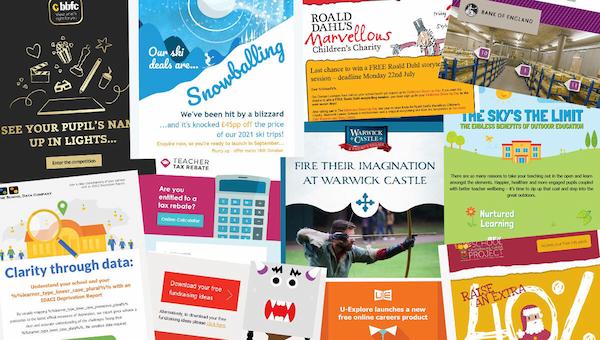
For many years, education marketing relied heavily on large-scale broadcast campaigns. Businesses could send heavily designed promotional emails to large groups of schools and still generate healthy enquiry volumes.
That environment has changed dramatically.
School staff now receive enormous volumes of supplier communication every week. As more businesses enter the education sector, inbox competition has intensified significantly, making it increasingly difficult for campaigns to secure attention.
At the same time, school filtering systems have become more advanced. AI filtering, stricter email security protocols, and evolving inbox categorisation systems mean many campaigns never properly reach educators in the first place.
Several broader sector pressures are also influencing engagement:
- Education budgets are tighter, forcing schools to scrutinise purchases more carefully.
- Staff workload pressures leave educators with less time to evaluate suppliers.
- Over-marketing within the sector has created fatigue towards generic campaigns.
- Trust and credibility have become increasingly important buying factors.
- Generic automation increasingly feels impersonal within relationship-driven school environments.
At Sprint Education, we’ve seen growing numbers of businesses reporting that campaigns which previously generated strong results are now producing fewer direct sales leads than they once did, particularly when campaigns rely heavily on broad targeting or repetitive messaging.
That certainly doesn’t mean traditional email marketing to schools has stopped working. Well-planned campaigns still play an important role in building brand awareness, generating website traffic, creating familiarity within the sector, and driving enquiries from schools when supported by strong targeting, timing, and messaging.
What has changed is that many education brands are now seeing the strongest long-term results when broader marketing campaigns are supported by additional relationship-building activity running alongside them.
Modern education marketing increasingly benefits from a combination of brand visibility, precise audience targeting, consistent engagement, and longer-term sales development working together throughout the academic year.
The Deliverability Crisis In Education Marketing
One of the least understood challenges within marketing to schools is deliverability.
Many businesses focus heavily on open rates, click rates, and email design while overlooking a far more important question: are campaigns actually reaching educator inboxes consistently?
School IT environments are often more restrictive than standard commercial environments. Filtering systems are designed aggressively to protect safeguarding, reduce spam, and minimise cybersecurity risks. As a result, many school marketing emails experience reduced visibility before educators even have a chance to engage with them.
Several factors can negatively impact deliverability within schools:
Over-Designed Email Templates
Highly designed templates containing large image blocks, excessive links, tracking scripts, or heavily promotional formatting often struggle within school environments.
Simpler email structures frequently achieve stronger inbox placement because they appear more natural and less commercially aggressive.
Poor Quality Education Data
Outdated school data damages sender reputation through higher bounce rates, failed deliveries, and lower engagement levels.
Reliable education databases play a major role in maintaining campaign health because cleaner data contributes directly to stronger deliverability performance.
Sprint Education's education database benefits from roughly 600,000 monthly updates across school and educator records, keeping up with staff changes in a fast-paced industry.
Excessive Tracking Technology
Many businesses are unaware that aggressive email tracking can reduce inbox placement. Certain tracking technologies create signals that filtering systems interpret negatively.
This is one reason why some education marketing campaigns show strong “open rates” but generate surprisingly weak engagement or lead generation.
Generic Sending Infrastructure
Most generic email platforms aren’t built specifically for education marketing environments. Education-dedicated infrastructure often performs better because sending behaviour can be optimised around how school servers process incoming communication.
The infrastructure powering Sprint Education’s school marketing campaigns generates, on average, a 9% higher inbox placement rate compared with more generic email delivery approaches.
Deliverability is becoming one of the defining competitive advantages within modern school marketing because visibility increasingly determines whether campaigns succeed at all.
Why Schools Ignore Most Supplier Emails
Many suppliers assume schools ignore marketing emails because educators simply aren’t interested. In reality, the issue is usually more nuanced.
Schools are overwhelmed with communication from suppliers who often sound remarkably similar. Many campaigns use identical language, similar subject lines, broad messaging, and generic claims around “saving time”, “improving outcomes”, or “transforming learning”.
As inbox competition increases, educators naturally become more selective about which messages deserve attention.
Campaigns are far more likely to underperform when they:
- Focus heavily on product features without connecting to school priorities.
- Use generic messaging across vastly different school audiences.
- Feel overly promotional or automated.
- Arrive too frequently.
- Target the wrong staff roles.
- Lack relevance to the recipient’s responsibilities or context.
By contrast, stronger-performing campaigns usually feel more conversational, more relevant, and more human.
Some of the best-performing school marketing emails are surprisingly simple. Rather than resembling polished advertising campaigns, they behave more like genuine professional communication between people who understand the education sector.
The Rise Of “Forever-On” School Sales Development
One of the biggest shifts happening within the education sector is the movement away from purely campaign-led marketing towards longer-term sales development approaches.
Traditionally, many businesses relied on occasional “burst” campaigns designed to generate immediate results. While these campaigns can still support brand visibility effectively, many suppliers now find they need additional activity working in the background to maintain engagement and generate a steadier flow of school sales leads.
This shift heavily influenced the development of Sprint IQ.
Sprint IQ was designed around the idea that modern education marketing needs to behave more like human relationship-building and less like repetitive mass broadcasting. Rather than relying solely on large campaigns, Sprint IQ combines broader brand awareness activity with conversational sales development emails launched gradually over time.
Internally, we often describe this approach as combining “fireworks and fire”.
The “fireworks” element focuses on larger marketing campaigns that generate visibility, traffic, awareness, and brand exposure across schools.
The “fire” element operates more steadily in the background through drip-fed sales development emails designed to warm relationships gradually, encourage direct responses, and maintain visibility over longer periods.
This approach reflects several major behavioural changes happening within school marketing:
Schools respond more positively to human communication.
Conversational emails that feel natural often outperform heavily promotional messaging because educators are increasingly resistant to communication that feels automated or overly sales-driven.
Repeated visibility builds familiarity and trust.
Schools frequently revisit suppliers months after initial engagement. Remaining visible consistently throughout the year significantly improves long-term lead generation opportunities.
Smaller volumes can generate stronger engagement.
Many businesses are discovering that sending fewer, better-targeted communications produces stronger results than increasing campaign frequency endlessly.
Relationship-building increasingly drives conversion.
Within education, trust often develops gradually. Schools are more likely to engage with suppliers they recognise, remember, and feel familiar with over time.
This doesn’t mean traditional education marketing campaigns have stopped working. Instead, the strongest-performing businesses increasingly combine brand-building activity with ongoing sales development systems designed to nurture schools more consistently throughout the academic year.
How Modern Education Brands Generate School Sales Leads
Lead generation within the education sector rarely happens through a single tactic alone. The businesses generating consistent school enquiries usually combine several connected strategies together.
Precise Audience Segmentation
Broad school campaigns often dilute relevance and reduce engagement. Stronger-performing organisations increasingly segment audiences carefully according to:
- School phase.
- Geography.
- Staff role.
- Curriculum relevance.
- Trust structure.
- Budget profile.
- Demographic indicators.
- School size and characteristics.
This allows campaigns to feel significantly more relevant to recipients.
Multi-Touch Visibility
Schools rarely convert immediately after seeing a supplier once. Many successful education brands maintain visibility through repeated touchpoints across email marketing, sales development, social proof, case studies, direct outreach, and retargeting activity.
Educational Positioning
The strongest campaigns usually position suppliers as knowledgeable sector specialists rather than purely commercial vendors.
Businesses that demonstrate genuine understanding of school pressures, funding challenges, curriculum demands, safeguarding responsibilities, or staff workload issues tend to generate stronger trust signals.
Long-Term Nurturing
Some school purchases happen months after initial engagement. Businesses that maintain professional visibility consistently throughout the year often generate stronger long-term returns than organisations relying entirely on short-term campaign spikes.
The Role Of Education Data In School Marketing
Education data plays a foundational role within successful school marketing campaigns. Even exceptional messaging will struggle if businesses target outdated records, irrelevant audiences, or the wrong decision-makers.
Many suppliers entering the education sector underestimate how difficult maintaining accurate school data can be. Staff movement, role changes, trust restructuring, and organisational changes happen constantly across schools, colleges, MATs, and districts.
Poor-quality data creates multiple problems simultaneously:
- Reduced deliverability.
- Higher bounce rates.
- Lower engagement levels.
- Weaker sender reputation.
- Wasted budget.
- Reduced targeting precision.
- Compliance risks.
Modern education databases increasingly function as far more than simple contact lists. Platforms such as Campus combine school data, segmentation tools, CRM functionality, and marketing infrastructure within a single education-focused environment.
This allows businesses to build more sophisticated campaigns targeting specific audiences across the education sector while maintaining stronger data quality and operational efficiency.
Selling To MATs Requires A Different Approach
Multi-Academy Trusts have become one of the most influential forces within UK education. However, many suppliers still approach MATs exactly as they would standalone schools.
This often creates problems because MAT purchasing structures can differ significantly from traditional school buying behaviour.
Some trusts centralise procurement heavily, while others operate more flexibly with schools retaining partial autonomy. Successful MAT selling therefore depends on understanding how individual trusts structure decision-making internally.
MAT-focused campaigns often benefit from:
- More strategic relationship-building.
- Trust-wide value propositions.
- Operational efficiency messaging.
- Scalability positioning.
- Strong case studies and credibility signals.
- Longer-term nurturing activity.
Trust-level selling can take longer initially, but successful MAT partnerships frequently create substantial long-term growth opportunities because they can unlock access across multiple schools simultaneously.
Marketing To International Schools
International education markets continue expanding rapidly, creating major opportunities for education suppliers capable of adapting their strategy effectively.
However, successful international school marketing requires more than simply exporting UK campaigns overseas.
Different regions operate according to different:
- Academic calendars.
- Curriculum structures.
- Purchasing cycles.
- Governance models.
- Cultural expectations.
- Communication styles.
- Budget structures.
Businesses expanding into international education markets also benefit from more refined school segmentation and regional targeting. You can explore our international and US school data by country, region, and establishment type here, helping you identify relevant schools across global markets more efficiently and create campaigns that feel more targeted, localised, and relevant.
Because competition is often lower within certain international education markets, organisations with strong segmentation and consistent visibility can establish valuable early positioning advantages.
The Future Of Selling To Schools
The education sector will continue evolving rapidly over the coming years. AI-driven filtering, rising inbox competition, changing procurement structures, MAT growth, and increasing pressure on school budgets will continue reshaping how suppliers engage with educators.
At the same time, schools still actively seek trusted suppliers capable of helping improve outcomes, reduce workload pressures, support operational efficiency, and enhance pupil experiences.
The businesses most likely to succeed long-term will usually be those that adapt to how modern schools actually buy.
That means:
- Building trust gradually rather than relying solely on short-term campaigns.
- Combining broad brand visibility with relationship-led sales development.
- Prioritising inbox placement and deliverability.
- Using stronger education data and segmentation.
- Developing campaigns that feel useful, relevant, and human.
- Understanding how schools operate internally.
Marketing to schools hasn’t stopped working. However, the methods generating the strongest results today are significantly more sophisticated, targeted, and relationship-driven than many of the approaches that dominated the sector several years ago.
For businesses willing to adapt, the opportunity within education remains enormous.
Turn Your School Marketing Strategy Into Action
Understanding how modern selling to schools works is one thing; building a strategy that consistently generates engagement, enquiries, and long-term growth is another entirely.
The education sector has become far more competitive over recent years, which means audience quality, campaign timing, deliverability, segmentation, and sales development now play a much larger role in performance than many businesses expect.
At Sprint Education, we work with education brands at every stage of growth – from organisations entering the sector for the first time, through to established suppliers looking to improve lead generation, increase school engagement, or strengthen their positioning within MATs and international markets.
If you’d like support turning the strategies covered in this guide into a practical growth plan for your organisation, you can book an education strategy call with our team.
During the session, we’ll explore your target audience, current challenges, growth objectives, and the marketing approaches most likely to help you generate stronger results within the education sector.
Whether you’re looking to improve school lead generation, strengthen campaign performance, build a more effective education database strategy, or explore how services such as Sprint IQ and Campus could support your growth plans, the session is designed to help turn strategy into action.
Tags
How to Sell to Schools
How to Sell to Teachers
Marketing to Education
Marketing to Schools
Marketing to Teachers
Selling to Schools
Selling to Teachers
Similar Articles

What's the Best Way to Market to Schools?
How to market to schools effectively with better targeting, role-based campaigns, and consistent email marketing.
Read Post
An Overview of the 2022 Exam Season
Read our 2022 exam cheat sheet, and find out what’s different about this year’s exams, and what you need to do to hit top marks during this period.
Read Post