





































Why Sales Enablement Is Reinventing School Marketing
Why Sales Enablement Is Reinventing School Marketing
Why Sprint IQ and sales enablement are reinventing school marketing, helping brands generate more school leads, and improve engagement.
Why Sprint IQ and sales enablement are reinventing school marketing, helping brands generate more school leads, and improve engagement.


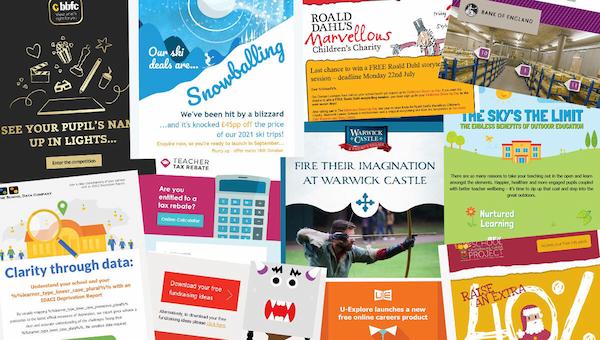
For over a decade, brands selling to schools could rely on a familiar campaign rhythm. A strong marketing email would build visibility, a plain-text follow-up would generate replies, and a carefully timed sales enablement sequence could help move interested schools further down the funnel.
We saw that structure generate results repeatedly across thousands of school campaigns. Over the past few years, however, that once-unshakable strategy was resulting in a slow yet noticeable drop in engagement. Over time, it became clear that the wider school marketing landscape was evolving, and the strategies generating the strongest pipeline would need to adapt quickly…
Why school marketing’s harder than ever
Over the past few years, school marketing has become far less predictable than it used to be. Campaigns that would once generate a reliable stream of replies and enquiries are now having to work much harder to maintain the same level of momentum.
Schools are receiving more and more emails from brands trying to sell to schools, so decision-makers are becoming far more selective about the messages they spend time engaging with. At the same time, school inbox filters have become much stricter because of the huge increase in email volume, creating a higher risk of marketing emails being pushed into junk or spam folders for increasingly smaller reasons.
That’s made maintaining engagement much harder than it used to be. Strong campaigns can absolutely still perform well, particularly when the targeting and messaging are solid, although they don’t always generate the same level of engagement on their own as consistently as they once did.
The campaign strategy that delivered results for years
For well over a decade, Sprint Education has encouraged clients to think beyond standalone campaigns.
One of the most successful approaches combined visually designed marketing emails with carefully timed plain-text follow-up emails. The designed campaigns would create awareness and establish credibility, while the plain-text message would prompt conversations. That structure worked because it reflected how schools typically buy; awareness first, followed by familiarity, trust and conversation.
Many education brands built highly successful school marketing strategies around this model, with some even asking us to manage their sales enablement sequences as the strategy would generate so many leads, they couldn’t manage them all in-house.
The combination of designed campaigns and human-style follow-up emails proved especially effective because it balanced visibility with familiarity. Schools recognised the brand from the campaign activity, then encountered more natural communication that felt relevant, timely and commercially useful.
When we knew the market was changing again
This approach worked almost perfectly for well over ten years. And then suddenly, it all changed. The combination of busy inboxes, inbox filtering, and increased pressures on school staff meant that the current approach was, at the same time, not enough to start conversations with decision-makers - and yet “too much” for inbox filters, in some cases.
From our perspective, simply increasing campaign volume wasn’t the answer. Schools were already receiving huge amounts of supplier communication, meaning more noise rarely translated into stronger pipeline, and there’s the increased risk of your domain getting marked as spam for blasting more emails.
The answer instead was to create a slower, more strategic layer of sales enablement designed to support campaigns over longer periods without overwhelming the audience.
That shift changed the thinking behind school marketing strategies. Maintaining momentum became just as important as generating initial visibility, particularly for education brands looking to create a more consistent pipeline throughout the year rather than relying heavily on short campaign bursts each term.
The slow-drip sales enablement model behind Sprint IQ
That changing market environment ultimately led to the development of Sprint IQ.
Traditional campaigns still play an important role in generating awareness and visibility, particularly when supported by strong creative, accurate targeting and quality education data. Sprint IQ was developed to strengthen that activity with a slower-drip sales enablement strategy focused on sustaining engagement, improving response quality and generating more consistent pipeline momentum over time.
At a high level, the model combines audience intelligence, inbox-first delivery strategies, human-style messaging and carefully controlled communication cadence to help education brands stay present with school decision-makers over longer periods. The approach is intentionally measured. Rather than relying on short spikes of activity, Sprint IQ focuses on creating gradual familiarity and ongoing engagement through communication that feels more natural and commercially relevant to schools.
A huge part of Sprint IQ sits behind the scenes in the dedicated email infrastructure we build for clients to help improve inbox placement and support long-term engagement. As school inbox filtering has become more aggressive, simply sending campaigns from a standard setup is no longer enough to consistently achieve strong delivery into school inboxes.
Sprint IQ combines that infrastructure with a slower-drip sales enablement strategy designed to maintain visibility and generate more natural conversations over time. In practice, it replicates the impact of hiring three experienced Sales Development Representatives alongside a full email infrastructure engineering team, giving education brands a much more sophisticated system for generating school engagement and pipeline without having to build that capability internally, alongside access to over one million educators and school decision-makers.
The results are changing school sales expectations
Sprint IQ campaigns generate an average response rate of 1.6%, with 61% of responses classified as hot leads and an average of 36 responses generated within the first 30 days. For many education brands, those numbers represent a significant improvement in the level of pipeline consistency they had become used to seeing from campaign-led activity alone.
The client stories bring those shifts into even sharper focus. One client generated 27 enquiries within the first three weeks of launching Sprint IQ after generating only 18 enquiries across the entire previous year using more traditional campaign structures. Another reported a 2,400% increase in sales leads compared with their previous average campaign returns.
What’s particularly notable is that these results aren’t necessarily being driven by dramatically increasing campaign frequency. In many cases, the strongest-performing strategies are actually more controlled and more measured than older approaches because the emphasis has shifted towards sustained engagement quality, ongoing visibility, and stronger commercial conversations over time.
That’s where this regular yet carefully planned sales enablement messaging is really reinventing school marketing. The strongest education brands are using our system designed to maintain familiarity, create conversations and support their pipeline continuously rather than concentrating all activity into a handful of major campaigns each year.
Now: school marketing is smarter, slower, and more strategic
Those seeing the most success when selling to schools right now are unlikely to be the brands generating the loudest visibility spikes or sending the highest volume of campaigns. Increasingly, stronger results are coming from strategies that maintain relevance over time, support sales pipelines more consistently, and create more natural engagement with school decision-makers.
Sprint IQ is a key example of how that evolution is already taking shape across the education sector. What began as a response to changing campaign performance has developed into a broader sales enablement model designed to help education brands generate stronger engagement, more meaningful conversations, and more sustainable pipeline growth.
For businesses selling to schools, the challenge over the next few years won’t simply be getting seen. Sustaining visibility, trust, and momentum in a market where attention is becoming harder to earn will increasingly separate the brands generating consistent pipeline from those relying solely on periodic campaign bursts.
Want to strengthen your school marketing strategy?
If your campaigns are generating visibility but not enough of a consistent pipeline, Sprint Education can help you identify where opportunities are being missed, and what stronger school engagement could look like for your business.
Book an education strategy call with our team to discuss:
- Your current marketing to schools strategy and campaign structure.
- The challenges affecting engagement, delivery, and lead generation.
- How sales enablement can support long-term pipeline growth.
- The latest trends we’re seeing across school marketing campaigns.
- Practical ways to improve conversations and engagement with school decision-makers.
With access to over one million educators and school decision-makers, alongside insights from thousands of education campaigns, Sprint Education helps brands build smarter strategies for selling to schools.
Tags
Marketing Strategy
Marketing to Education
Marketing to Schools
Marketing to Teachers
Similar Articles
Campus Marketplace: VIP Access to Our Edu-Marketing Experts
Introducing Marketplace. Giving Campus users one-click access to the UK's foremost education marketing content specialists.
Read Post
Summer School for Edu-Marketers: Top Reads & Insights
Prepare yourself for September with our essential reports, blogs and videos designed to quench your edu-marketing thirst.
Read Post