



































Why Do School Marketing Emails Go to Spam?
Why Do School Marketing Emails Go to Spam?
Discover how to improve school email deliverability, avoid spam filters, and reach more teachers with tips from the education marketing experts.
Discover how to improve school email deliverability, avoid spam filters, and reach more teachers with tips from the education marketing experts.



You've spent time building your audience, crafting your email, choosing the perfect subject line, and pressing send with high expectations. A few days later, the results arrive, and… they're not great. Open rates are lower than expected, clicks are scarce, and enquiries simply haven't materialised.
For many businesses, the natural reaction is to question the email itself. Perhaps the copy wasn't engaging enough, the offer wasn't compelling enough, or the timing was wrong.
Sometimes that's true. However, another possibility is often overlooked: the email never reached enough school inboxes in the first place.
School email deliverability is one of the most misunderstood aspects of marketing to schools. Unlike many other B2B sectors, schools operate within highly protected IT environments where filtering systems work constantly behind the scenes to reduce spam, block phishing attempts, and protect staff from malicious emails. As a result, reaching educators consistently has become more challenging than many businesses realise.
At Sprint Education, we've supported more than 14,000 organisations with marketing to schools and manage millions of education contacts across the UK and internationally. Over the years, we've seen first-hand how small deliverability improvements can have a significant impact on campaign performance.
In this guide, we'll explain why marketing emails to schools go to spam, how school filtering systems work, and what businesses can do to improve school email deliverability.
Where do your emails actually go?
One of the biggest misconceptions in email marketing is that there are only two deliverability outcomes: successful delivery to a teacher’s inbox, or diverted delivery to their spam folder.
In actuality, it's not an ‘either/or’ situation, and there are several journeys your school marketing email can take:
- Be delivered successfully into the recipient's inbox.
- Be diverted into a junk or spam folder.
- Be quarantined by the school's security systems.
- Be rejected before it's delivered.
- Be filtered into another mailbox category that receives little attention.
From the sender's perspective, these will all result in largely the same outcome: open rates fall, enquiries decrease, and campaign performance suffers. Some of these outcomes can have quite easy fixes, yet it's often impossible to tell exactly where the problem occurred without specialist deliverability monitoring - meaning the practical solution is to do everything you can in advance to reduce the chances of your email ending up anywhere other than the inbox.
That's why school email deliverability deserves far more attention than it sometimes receives. Businesses understandably spend considerable time refining subject lines and email content, while a much more fundamental question sometimes goes unasked: are enough educators actually seeing the email in the first place?
Why school email systems are different
Schools face a constant stream of phishing attempts, malicious attachments, spam campaigns, and fraudulent emails. Protecting staff, pupils, and school networks is therefore a major priority for IT teams and managed service providers.
Many schools also operate with limited IT resources, meaning they rely on sophisticated filtering platforms that automatically assess incoming emails before they ever reach staff inboxes. These systems evaluate hundreds of different signals, helping schools block suspicious communication without requiring manual intervention.
In recent years, more and more marketing agencies are offering school marketing services - except a good chunk of them aren’t education experts, and others are cutting quality to cut prices. That means the quality of education emails are dropping, and in a fight to combat spam and sheer volume, email filters are getting tighter and tighter.
Education is also an attractive target for cybercriminals. Schools hold sensitive personal data, operate large user bases, and frequently communicate with external organisations. Strong email security is therefore essential.
This creates a slightly different environment from other B2B businesses. Emails that arrive safely in corporate inboxes may face much greater scrutiny when they're sent to schools.
Understanding this context is important because it changes how businesses should approach email marketing within education. It’s not enough to say ‘I want to avoid the spam inbox’ - you need to reframe your thinking as ‘I want to send emails that school systems recognise as trustworthy, relevant, and safe’.
The biggest reasons marketing emails get blocked by schools
There isn't one single reason why school marketing emails go to spam. Instead, deliverability is influenced by many different factors working together.
Too many images
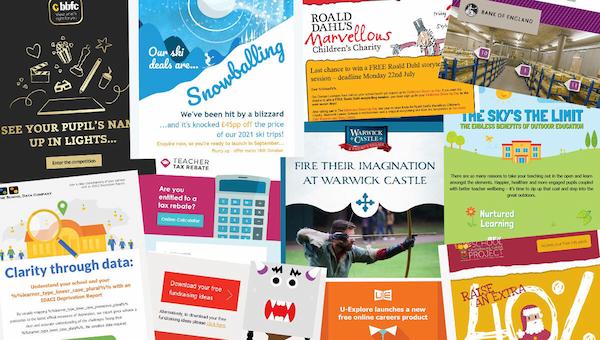
Highly designed newsletters filled with banners, graphics, icons, and promotional imagery often struggle within school environments.
While high-quality images certainly have their place, campaigns that rely heavily on visuals sometimes appear more promotional to filtering systems. You should ideally aim for an image:text ratio of no higher than 40:60, and you should take care to not embed too much text in an image, as this can also flag spam filters, as scammers will frequently try and ‘hide’ harmful text in an image - which filters are now able to detect.
This doesn't mean every email should be plain text. Instead, businesses should think carefully about whether every image genuinely improves the reader's experience, or simply adds unnecessary weight to the email.
Too many links
Links are another important signal.
Most legitimate marketing emails contain links, but excessive linking can increase suspicion, particularly when multiple tracking URLs, social media links, downloadable resources, and calls to action all compete within the same message.
Every additional link introduces another element that filtering systems may assess. Keeping emails focused, with fewer but more meaningful calls to action, often creates a cleaner experience for both recipients and email providers.
This will also have the benefit of streamlining the experience to make it easier for teachers to understand what to do. If you give teachers three landing page links, they’re more likely to click away due to being overwhelmed, even subconsciously. One clear landing page link will tell teachers exactly where you want them to go, and they’ll be more likely to follow.
Poor sender reputation
Sender reputation is one of the biggest influences on deliverability, yet many businesses rarely think about it.
Every domain gradually develops a reputation based on previous sending behaviour. High complaint rates, poor engagement, excessive bounce rates, or sending to outdated contact lists can all damage that reputation over time.
Once your sender reputation begins to decline, future campaigns may find it increasingly difficult to reach inboxes consistently.
Building a positive sender reputation takes time, consistency, and good sending practices. Unfortunately, damaging that reputation can happen much more quickly.
At Sprint Education, we own our own servers which are primed for education inboxes and only used by our clients, meaning you’re not sharing server space with anyone sending low-quality or spam emails. Not every marketing agency can guarantee this, as most of them rent servers from third parties - meaning they have no idea what else is sending through those servers, and what is impacting your sending reputation.
New or poorly warmed domains
Businesses launching email marketing for the first time often underestimate the importance of domain warming.
Sending large campaigns immediately from a brand-new domain can appear unusual because email providers haven't yet built confidence in the sender's behaviour.
Gradually increasing sending volumes allows reputation to develop naturally, helping establish greater trust over time.
While domain warming won't solve every deliverability issue, it forms an important part of a healthy long-term email strategy. Not everyone will want to hold off their campaign for a few weeks while they warm domains - but when a poor sending reputation can take months to reverse, it’s always worth the effort.
Poor-quality education data
The greatest of school marketing campaigns will fail when they’re built on poor or outdated data.
Schools experience change more frequently than other industries. Staff move roles, retire, change schools, or leave the industry altogether. Academy conversions, trust restructures, and organisational changes all contribute to records becoming outdated surprisingly quickly.
Poor quality data often leads to:
- Increased bounce rates that damage sender reputation.
- Reduced engagement because messages reach the wrong people.
- Wasted marketing budget on inactive records.
- Damaged sender reputation that makes future campaigns harder to deliver.
Using well-maintained education data significantly improves campaign quality from the very beginning.
At Sprint Education, our education database benefits from approximately 600,000 monthly updates across school and educator records, helping businesses work from more accurate information throughout the year.
Excessive email tracking
Email tracking has become one of the biggest talking points within deliverability over recent years.
Many marketing platforms automatically insert tracking pixels, hidden code, and additional tracking links into every campaign. While these tools can provide useful reporting, they also increase the complexity of each email.
Within school environments, where security filtering is already more aggressive, unnecessary tracking technology can sometimes contribute to reduced inbox placement.
That's one reason why businesses should avoid becoming overly reliant on tracking metrics alone. Reporting remains valuable, but achieving stronger inbox placement should always be a priority; it’s a poor trade-off knowing one school opened an email if it means ten other schools don’t receive it altogether.
Generic email infrastructure
School email systems don't always respond well to the same platforms businesses use for general marketing.
Many standard email tools are built for broad commercial use, which means they aren't always set up around the specific challenges of marketing to schools, such as stricter filtering, safeguarding controls, and education-specific sending behaviour.
At Sprint Education, our education-dedicated email infrastructure generates, on average, a 9% higher inbox placement rate than more general email delivery methods because it's been built specifically around the requirements of the education sector.
Infrastructure won't compensate for poor campaigns, but it can make a meaningful difference when combined with good data, thoughtful content, and strong sending practices.
Common deliverability mistakes businesses make
Deliverability problems rarely stem from one major mistake. More often, they're the result of several smaller issues gradually affecting campaign performance.
Some of the most common mistakes include:
- Sending large campaigns immediately from brand-new domains without allowing reputation to develop naturally.
- Continuing to use outdated school contact data that generates unnecessary bounce rates and damages sender reputation.
- Overloading emails with images, graphics, buttons, and promotional content that increase filtering risk.
- Inserting excessive tracking technology into every campaign without considering its impact on inbox placement.
- Ignoring bounce reports rather than investigating why messages aren't reaching schools.
- Sending identical campaigns repeatedly without refining targeting or messaging.
- Focusing exclusively on open rates while overlooking wider deliverability indicators.
None of these issues guarantees poor performance on its own. However, when several occur together, the likelihood of deliverability problems increases significantly.
How to improve school email deliverability
Improving deliverability usually comes down to consistent sending habits, careful campaign planning, clean education data, and a stronger sender reputation built over time.
Build sender reputation gradually
Healthy sender reputation develops through consistent, responsible sending behaviour.
Launching sensible campaign volumes, maintaining clean data, and monitoring bounce rates all contribute towards stronger long-term performance.
Keep emails clear and conversational
The best-performing school marketing emails are often remarkably straightforward.
Clear messaging, logical structure, sensible formatting, and genuinely useful content frequently outperform heavily designed promotional emails competing for attention.
Invest in accurate education data
Audience quality influences almost every aspect of campaign performance.
Maintaining accurate school and educator data reduces bounce rates, improves targeting, strengthens engagement, and helps protect sender reputation over time.
Think carefully about timing
While timing doesn't directly determine whether an email reaches a school inbox, it can influence the engagement signals that help build a healthy sender reputation over time.
Schools don't behave like typical commercial organisations. Exam periods, holidays, inset days, budget planning, inspections, and the wider education calendar all affect when educators have the time and capacity to engage with supplier emails. Campaigns launched at more appropriate points in the academic year are more likely to generate opens, clicks, and replies, helping reinforce positive sending signals for future campaigns.
Use tracking thoughtfully
Tracking can be useful for reporting, but it can also add hidden code, pixels, and extra URLs that make an email more complex than it needs to be.
Within school environments, where filtering systems are often stricter, businesses may need to sacrifice tracking to improve the chances of emails reaching more school inboxes. You may lose your granular reporting, but you’ll have a cleaner email that reaches more schools overall - which is the real goal.
Is it a deliverability problem - or a content problem?
When a school marketing campaign underperforms, it can be difficult to know whether the issue sits with deliverability, the audience, or the email content itself.
Low open rates may suggest the subject line didn't work, but they can also point to inbox placement issues. Low clicks may suggest the offer wasn't strong enough, but they can also happen when the wrong staff roles have been targeted. A lack of enquiries may suggest the campaign failed, but it may simply mean the campaign reached schools at the wrong point in the academic year.
The best starting point is to look for patterns across several campaigns, rather than making big decisions based on one send.
If engagement is low across every audience, topic, and launch date, deliverability or sender reputation may need closer attention. If some campaigns perform well while others don't, the issue is more likely to sit with targeting, timing, messaging, or the relevance of the offer.
That's why school email deliverability should be reviewed alongside campaign strategy, rather than treated as a separate technical issue. Stronger inbox placement gives campaigns a better chance of being seen, while stronger content gives educators a better reason to respond.
Keep your school marketing inbox-safe
School email filtering is constantly changing, which means businesses can't rely on the same sending habits forever. What reached educators a few years ago may face more scrutiny today, especially when campaigns use outdated data, heavy design, excessive tracking, or poorly warmed sending domains.
The good news is that deliverability can be improved. Cleaner education data, stronger sender reputation, simpler campaign design, carefully managed tracking, and education-focused infrastructure all help more emails reach school inboxes consistently.
If you're unsure whether poor campaign performance is being caused by deliverability, audience quality, or campaign strategy, book an education strategy call with our team. We'll help you identify where performance may be slipping, and how to build a stronger school marketing strategy.
Tags
Education Marketing
Email Marketing
Emailing Schools
Emailing Teachers in Schools
Schools Marketing
Similar Articles

Value Assets and Their True Worth
Become a lead-magnet legend and sell more to schools with our free 11-step guide to creating value assets that teachers can't resist.
Read Post
Marketing School Management Services to Schools
Learn 10 game-changing insights especially for school management service providers to enhance your education marketing campaigns when emailing schools.
Read Post